In this blog I have listed the 10 basic terms in Photography which are used regularly in the field of Photography.
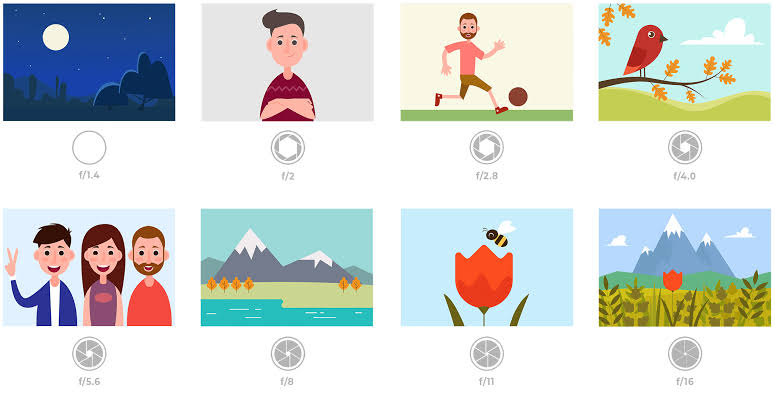
- Aperture: The opening in the lens through which light passes. Aperture is measured in f-numbers (e.g., f/2.8, f/8) and determines the amount of light entering the camera and the depth of field in a photograph. A lower f-number (e.g., f/2.8) represents a wider aperture and a shallower depth of field.
- Shutter Speed: The duration for which the camera’s shutter remains open, allowing light to reach the camera’s sensor. Shutter speed is measured in fractions of a second (e.g., 1/1000, 1/60) and controls the exposure and motion blur in an image. Faster shutter speeds freeze action, while slower shutter speeds create motion blur.
- ISO: ISO refers to the sensitivity of the camera’s image sensor to light. It is expressed as an ISO number (e.g., ISO 100, ISO 800). Lower ISO values (e.g., ISO 100) are less sensitive to light and are ideal for well-lit conditions, while higher ISO values (e.g., ISO 800) are more sensitive and are suitable for low-light situations. However, higher ISO values can introduce digital noise or grain in the image.
- Depth of Field: The range of sharpness in a photograph, from the foreground to the background. A shallow depth of field results in a blurred background, while a deep depth of field keeps most of the image sharp from front to back. Aperture, focal length, and distance to the subject affect the depth of field.
- Focal Length: The distance between the lens and the camera’s image sensor when an image is in focus. Focal length is measured in millimeters (mm) and determines the field of view and magnification of a lens. Shorter focal lengths (e.g., 24mm) provide a wider field of view, while longer focal lengths (e.g., 200mm) offer narrower angles of view and magnification.
- Composition: Composition refers to the arrangement and placement of elements within the frame of a photograph. It involves considering factors such as the rule of thirds, leading lines, symmetry, and balance to create visually appealing and engaging images.
- White Balance: White balance adjusts the color temperature of an image to ensure that white appears as neutral white, regardless of the lighting conditions. It helps maintain accurate and natural color representation in photographs.
- Exposure: Exposure refers to the overall brightness and tonal range of an image. It is determined by the combination of aperture, shutter speed, and ISO. Proper exposure balances these settings to achieve the desired level of brightness and detail in the photograph.
- RAW: RAW is an uncompressed file format that captures and preserves all the data recorded by the camera’s sensor. Unlike JPEG, RAW files offer more flexibility in post-processing, allowing for adjustments in white balance, exposure, and other settings without significant loss of image quality.
- Rule of Thirds: The rule of thirds is a compositional guideline that divides the frame into a grid of nine equal sections by two horizontal and two vertical lines. Placing key elements of the photograph along these lines or their intersections often results in a more balanced and visually pleasing composition.
These are just a few basic terms to get you started in photography. Understanding and applying these concepts will help you gain better control over your camera and improve your ability to capture captivating images.




 Photography Corner
Leave a comment